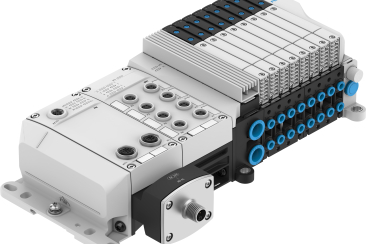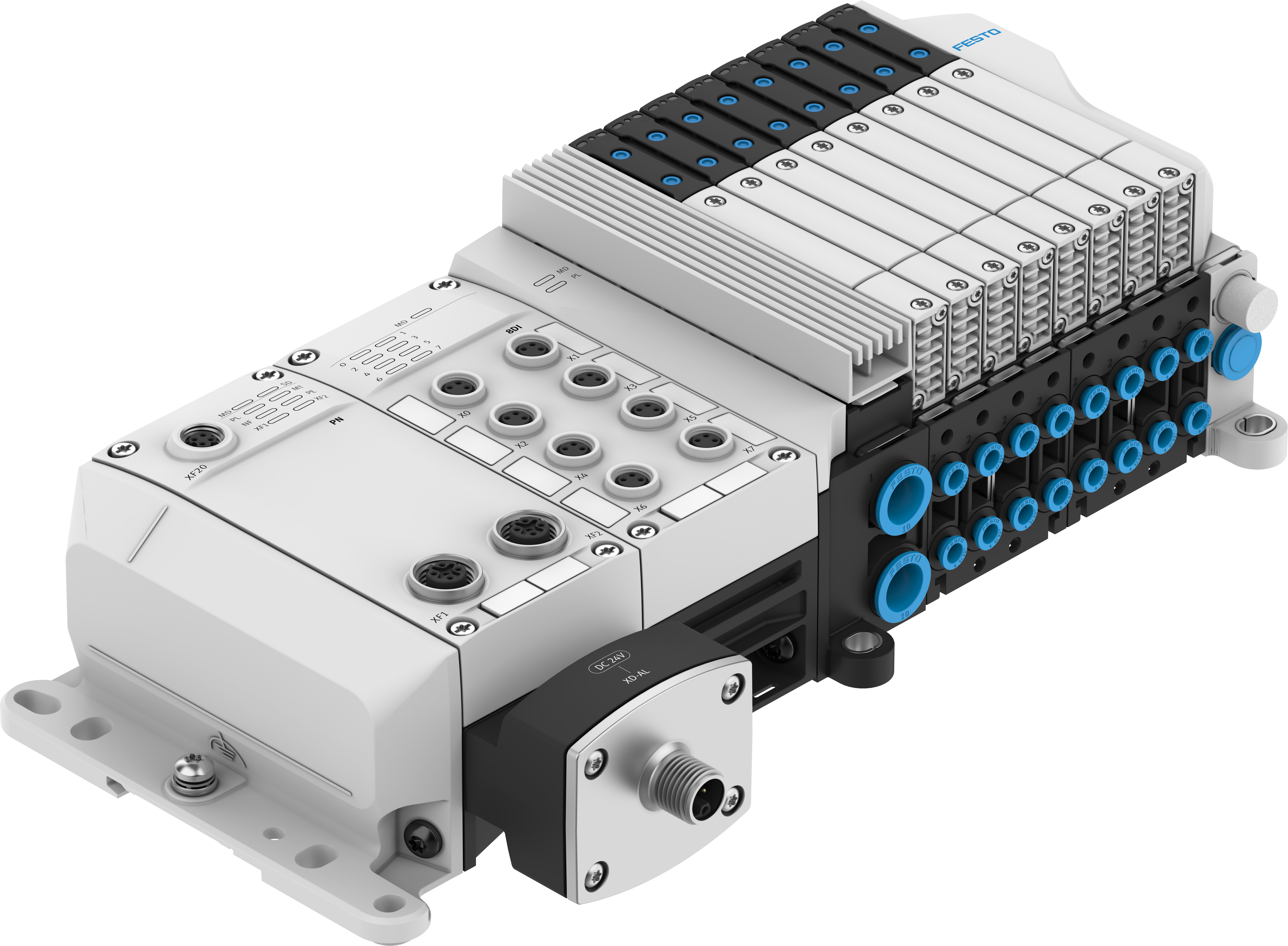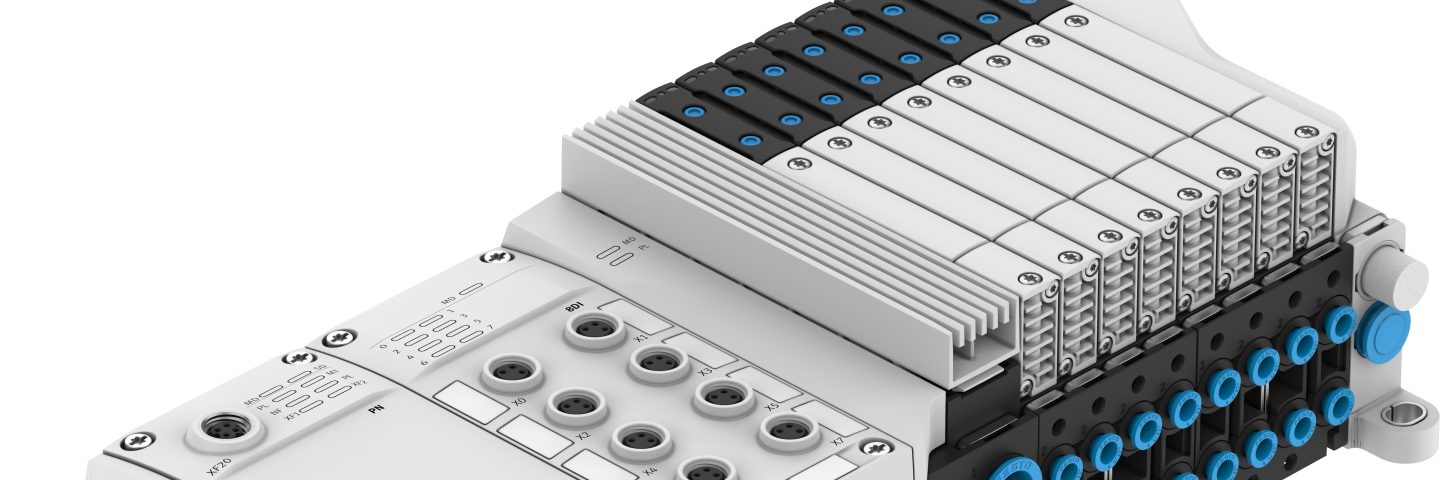
Festo Expands VTUX Valve Terminal
The VTUX was initially launched with basic capabilities to meet the broad needs of most volume users of pneumatic solenoid valve manifolds. Since its introduction, there has been a continuous roll-out of new features, making things even easier for users. The basic VTUX valve terminal is carefully cost-optimised through design and manufacture, delivering high flow rates and virtually unlimited modularity. The valve modules can be arranged freely and are compact and lightweight, saving time, space, and weight in the machine. The ability to ‘split’ manifolds cost-effectively without having to pay for additional fieldbus nodes means designers can arrange their layouts for ease of assembly and simpler maintenance. Crucially, the VTUX minimises piping run lengths, which can improve response times and cycle rates at the same time as reducing wasted ‘dead air’ volumes.
Open communication with Festo AP
However, the greatest benefits result from Festo considering not only how to mount and connect pneumatic solenoid valves across a machine but also the surrounding architecture. VTUX now uses Festo AP (Automation Protocol) to optimise digital communication. This brings flexibility, enables open architectures, and allows seamless integration of electrical and pneumatic automation.
With AP, VTUX becomes part of a digitised automation platform, enabling sensor integration, advanced diagnostics and predictive maintenance through data exchange with the cloud in the Industrial Internet of Things (IIoT). Festo’s CPX-AP-I remote I/O system with IP65/67 protection enables real-time communication via Ethernet-based fieldbus. Seamless connectivity also supports all other technologies, such as IO-Link or direct fieldbus integration. A recent addition is the innovative CTED multi-protocol node, which enables compact, flexible and cost-effective connections directly to all common Industrial Ethernet (fieldbus) hosts.
Whether the system is central, decentralised, or hybrid, VTUX with Festo AP offers scalable configurations, integrated safety functions, and flexibility for the customer’s machine concept. Consequently, machines communicate more efficiently, grow flexibly, and meet the highest safety standards – from compact single applications to complex networks.
Better end-of-arm performance
The lightweight design of the VTUX means it can be deployed on the front-end unit, a portal, or a robot arm, enabling short and efficient compressed air lines. Innovative new features include optional individual input modules for ultimate flexibility and logical commissioning and diagnostics. The ability to specify one, several or all slices with a smart vacuum generator further enhances reach and flexibility. This option is particularly attractive in end-of-arm applications where reduced piping and cabling make assembly faster. Fewer snag and wear points, combined with the reduced footprint and moving mass, create significant performance enhancements.
More sustainable operation
Performance and sustainability combine in the new Smart Switch Lite. With this option, a 5/4-way valve on the VTUX valve terminal enables the supply air to be switched off during cylinder movements. This saves energy and optimises the cycle time simultaneously. Despite the supply air being switched off, the cylinder reliably reaches its end position due to the residual expansion energy. In addition, the cylinder chambers can be individually exhausted and blocked, which enables precise control and greater flexibility. Reduced pressure in the end position ensures that the subsequent movement can take place with greater dynamics, enabling faster and more efficient processes.
Commenting on the ongoing development of VTUX functionality, Festo’s GB Product Manager Jonny Mottram said: “VTUX technology is continuously evolving to meet the automation needs of our customers, and we have further exciting new VTUX features planned for 2026. I’d urge machine builders seeking to increase their machines’ performance while reducing costs to make use of the national network of Festo Applications Engineers. Their extensive try-out facilities can significantly reduce the time and risk of changes by thoroughly modelling and testing your solutions.”