

Automation of organs-on-a-chip for drug development
The development of drugs takes a long time and is very costly: a drug candidate first undergoes several preclinical studies on cell cultures or animals. Clinical trials on humans follow in the final phase before authorisation. In this phase, an average of five drug candidates are tested per drug, four of which fail in the end - so-called late fails. The reason for this is that the results of preclinical studies often do not translate well to the human organism.
Much better results are achieved with so-called organs-on-a-chip from the bioprinter, on which efficacy and side effects can already be tested more precisely in the preclinical studies. Unsuitable candidates are thus eliminated at a much earlier stage, saving time and money. Organ-on-a-chip (OoC) refers to microfabrication processes that are used to create miniature models of organs such as the heart, lungs or intestines. Cells are arranged and cultivated on prefabricated polymer or plastic carriers in such a way that they form organ-like tissue.
Precise fluid control for tissue engineering
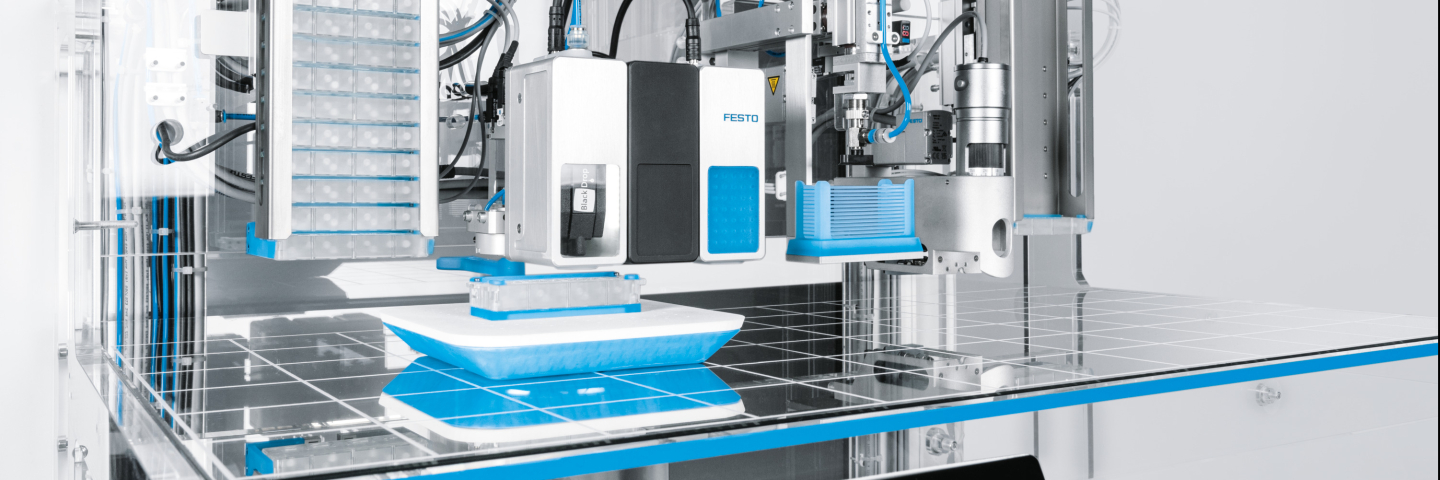
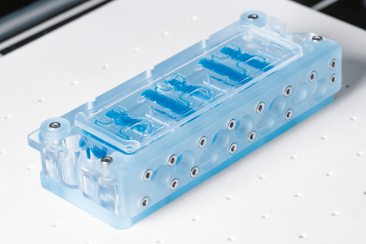
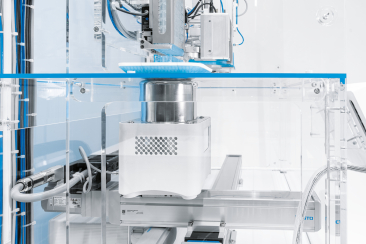
Together with experts from TU Darmstadt, Festo is demonstrating how the bioprinting process can be automated - including a solution for the contactless transport of microfluidic chips equipped with bonded manifold technology. Bonded manifolds are multi-layered plastic manifold plates with finely structured microchannels that enable the precise dosing and handling of liquids.
SupraMotion: contactless working in the laboratory of the future
Transport through the various steps in the production process is carried out using Festo's unique superconductor technology. This allows objects to be transported contactlessly on a magnetic levitator. The kinematic system remains outside the clean room and does not carry any particles away. The surfaces are kept clean and are easy to clean. The innovative technology can be combined with automation solutions for the life science sector to create a reliable overall concept that fulfils the highest cleaning and cleanliness requirements.
Diffusion Bonded Manifolds from Festo: Nominated for the Hermes Award 2026
Festo is among the three nominees for the Hermes Award 2026 with its Diffusion Bonded Manifolds. The Hermes Award is one of the world's most prestigious industry prizes and is presented at the Hannover Messe for outstanding innovation - products and solutions with a particularly high degree of technological innovation will be honoured on 19 April 2026.
Festo as an automation partner for life sciences
With flexible automation solutions, Festo supports the transfer of innovative therapies into clinical practice and makes state-of-the-art biotechnology available where it is needed. With the help of its product portfolio of pneumatics, electrics, software and AI, Festo realises the perfect seamless automation solution together with the customer. www.festo.com/lifetech
LifeTech
Bionic