Top tips to improve your next electric drive system’s performance
“Mistakes we commonly see include undersized motors on vertical axes, incorrect gear ratios, and a failure to align the guides correctly — all causing sub-optimal machine performance and premature component failure,” says Ben Lloyd, EA Product Manager at Festo. The knock-on effects for end users can include higher energy consumption, increased maintenance costs, and lower productivity.
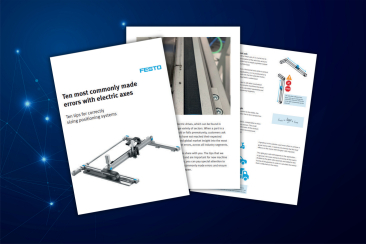
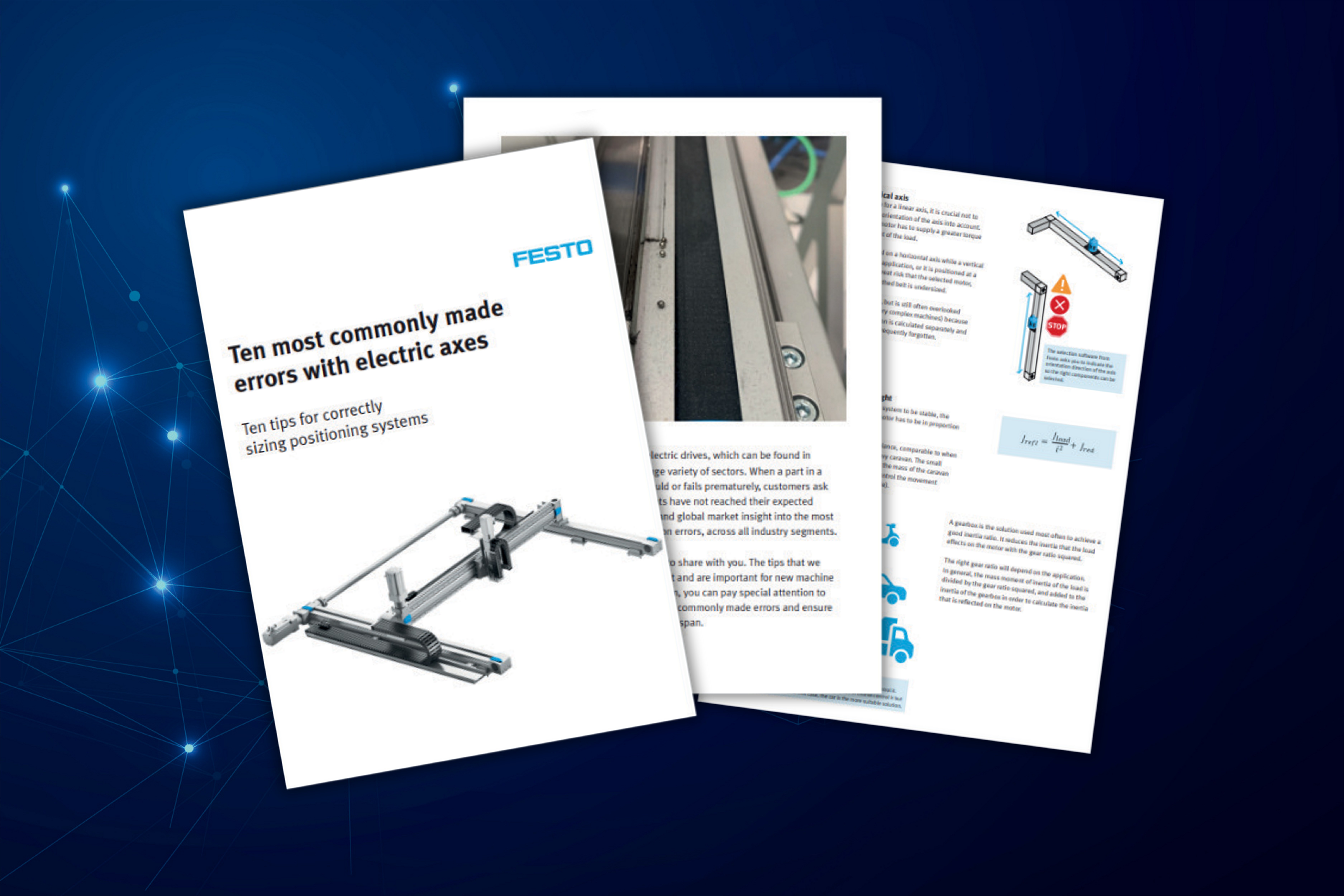
Based on the findings from investigations into premature component failure, Festo has compiled 10 Most Commonly Made Errors With Electric Axes, a free-to-download guide that identifies common errors and offers best practice advice for optimising electric automation system performance. Festo’s top tips include:
1. Factor in vibration
When selecting a linear axis, specifiers rightly refer to the manufacturer’s datasheet to obtain information regarding the correct power and torque parameters. However, environmental conditions such as vibrations must also be factored in to ensure that the desired lifetime is achieved. Failure to consider environmental conditions can result in a much shorter actual life time than predicted, based on your chosen power and torque.
More accurate predictions of component lifetime can be achieved by applying a specific factor to the load, as a function of the expected vibration, during the calculations. This factor lies between 1³ and 2³ and indicates the strength of the impact of the vibrations on the lifetime. The datasheet for each component will state how the impact of vibrations on the service life can be calculated.
2. Ensure full lubrication
Electric automation components are sometimes required to make repeated very short and precise movements. This can pose problems with effective lubrication, which leads to components sticking or failing. For example, a ball screw drive has a grease reservoir that ensures the drive is continuously lubricated during operation. In applications in which only a very limited stroke length is used, the balls in the ball screw assembly hardly move at all and so are not coated with any new grease.
In such cases, an extended stroke, or “lubrication stroke”, should be made periodically. Ideally, this action would be programmed into the machine software: for instance at the end of every shift or every production series. Lubrication requirements must be considered during the design phase to ensure that a movement over a longer stroke length is possible.
3. Thermal performance
The thermal model of the motor and drive plays an important role in correct drive selection. Heating and cooling cycles are typically influenced by whether the application requires the electric drive to operate continuously or intermittently. In applications with intermittent operation, the components have time to cool down. This has a positive impact on their service life, which means it is often possible to select a less powerful version than for continuous operation.
Festo’s Electric Motion Sizing tool helps specifiers and machine builders to factor this in. Users simply enter the dwell times between the movements alongside other typical application requirements such as motion, mass and speed. The online tool provides additional helpful manufacturer-independent tips for consideration in new machine designs.
Considering vibration, lubrication and thermal performance are just three ways to improve your electronic drive’s performance and life cycle. However, for a broader overview Festo has gathered more tips, based on its experience in the field, and compiled them into a free-to-download guide called Ten Most Commonly Made Errors With Electric Axes. Use it next time you design a system to avoid making avoidable errors and ensure that your electric drives last their full life span.
Festo’s 10 Most Commonly Made Errors With Electric Axes can be downloaded here: www.festo.com/common_errors_electric_axis
Festo is a global leader in automation technology setting international standards in industrial automation and technical education. The company provides pneumatic and electric automation solutions for factory and process automation across a wide range of industries.
Digitalisation, artificial intelligence and the rapidly growing LifeTech sector, including medical technology and laboratory automation, are becoming increasingly important areas of innovation for Festo. Sustainability, reducing its CO2 footprint, digital learning, innovation, performance and speed are key drivers for the company's future.
Festo products and services are available in 176 countries. With around 20,600 employees in more than 250 branch offices in around 60 countries, the company achieved a turnover of €3.33 billion in 2025. More than 8% of this is reinvested in research and development, and as a learning company, 1.5% of turnover is invested in basic and further training.
Festo Didactic, the company’s technical education and training division, is a leading global provider of technical training solutions, offering comprehensive digital and physical learning environments for industrial skills development.