This content was translated automatically.
Open automation for the AI era with Festo AX Controls
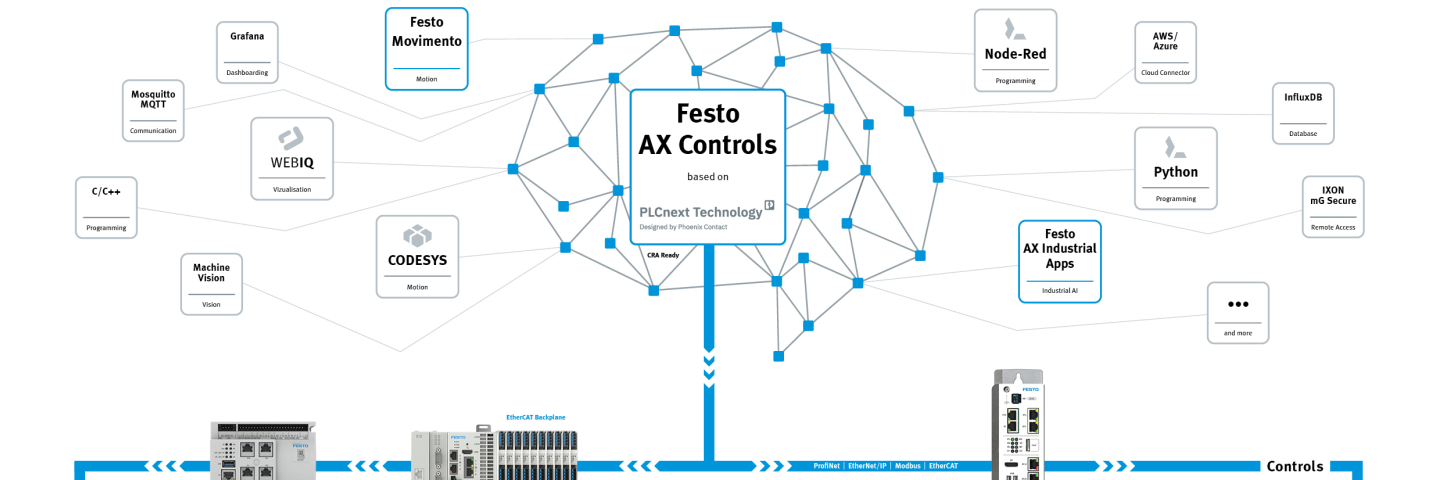
Festo AX Controls combines control, motion control, visualisation and cloud connectivity within a single architecture. The platform supports both PLC programming in accordance with IEC 61131-3 and high-level languages such as Python, and brings together automation, data analysis and AI applications.
Open ecosystem broadens horizons
A key feature of Festo AX Controls is its open ecosystem. Functions can be extended using apps from Festo, applications from the PLCnext Store and third-party solutions. Support for numerous communication standards also enables seamless integration into existing machine and production environments.
The technological foundation is provided by Phoenix Contact’s PLCnext Technology. Together with partners, this creates an open automation ecosystem. It combines control technology, motion control and robotics, as well as cloud connectivity, AI and software development.
Added value for customers and users
Customers benefit from reduced complexity and faster implementation of machine developments, as they can combine different programming languages, apps and communication standards on a single platform. The open approach avoids vendor lock-in whilst also enabling the use of open-source technologies.
A project from the food industry demonstrates how this approach works in practice. In this project, image processing, motion control, human-machine interface and cloud connectivity are consolidated on the high-performance edge controller CEPE. Whilst motion control is handled via CODESYS, a Python application takes care of image processing and data analysis.
High performance for demanding motion applications
The platform also performs impressively in complex motion control tasks. In a customer project for the printing and packaging industry, the CEPE controls more than 60 synchronised axes with cycle times in the low millisecond range. Festo AX Controls thus also meets the high demands for dynamics, precision and scalability.
Software as a driver of innovation
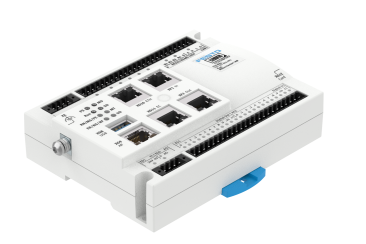
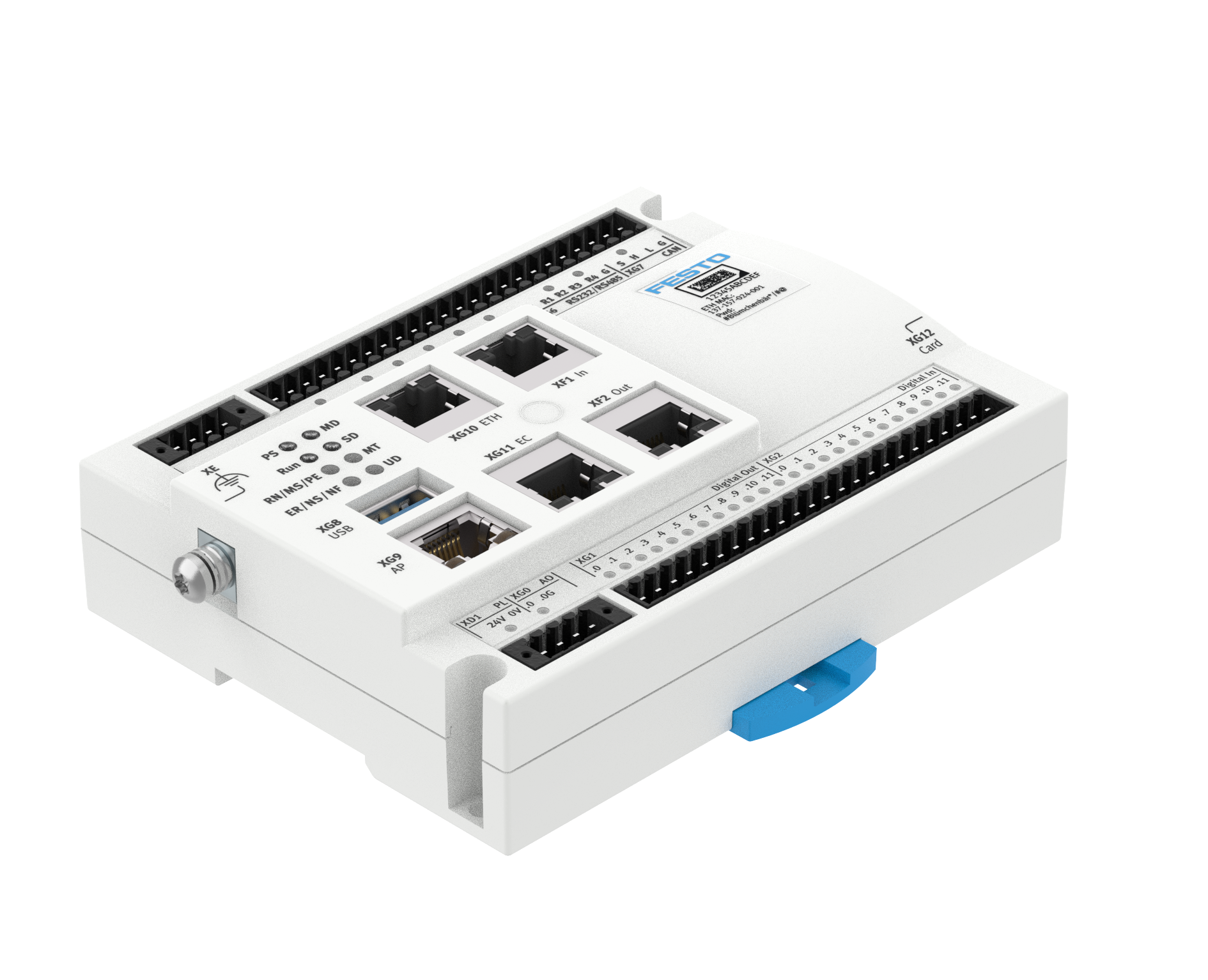
Festo AX Controls comprises software components ranging from operating systems and control software through to visualisation tools, high-level languages, low-code tools and engineering tools. The portfolio is complemented by scalable hardware solutions, ranging from the CECC-AX compact controller and the CPX-R modular plug-in system to the high-performance CEPE edge controller.
“Software offers enormous potential for innovation, both for us as an automation manufacturer and for our customers in the mechanical and plant engineering sectors,” explains Dr Wolfgang Sperling, Head of the Electric Automation Business Unit at Festo. “Festo AX Controls enables faster and simpler integration of various automation components and speeds up the engineering, commissioning and programming of machines and plants.”
Festo at SPS in Nuremberg: Hall 9, Stand 305
Festo is a global player and an independent family-owned company with headquarters in Esslingen am Neckar, Germany. Festo has set standards in industrial automation technology and technical education ever since its establishment, thereby making a contribution to sustainable development of the environment, the economy and society. The company supplies pneumatic and electrical automation technology to 300,000 customers of factory and process automation in over 35 industries. Digitalization, AI and the LifeTech sector with medical technology and laboratory automation are becoming increasingly important. The products and services are available in 176 countries. With about 20,600 employees in over 250 branch offices in around 60 countries worldwide, Festo achieved a turnover of around €3.33 billion in 2025. More than 8% of this turnover is invested in research and development. In this learning company, 1.5 % of turnover is invested in basic and further training. Festo Didactic SE is a leading provider of technical education and training and offers its customers worldwide comprehensive digital and physical learning solutions in the industrial environment.