This content was translated automatically.
Everything under control from battery cells to electric motors
The battery cells alone account for around 40% of the added value in the production of an electric vehicle. On no other continent is the production capacity for lithium-ion batteries increasing as quickly as in Europe.
At the same time, the production processes for the electrified powertrain are changing. While semi-automated production processes have dominated traditional automotive manufacturing with combustion engines to date, the manufacture of battery cells and electric motors is increasingly developing into fully automated production processes. As a leading manufacturer of automation technology, Festo has the right solutions for this along the value chain - from battery cell production to the assembly of electric motors.
The battery cells alone account for around 40 per cent of the value added in the production of an electric vehicle. On no other continent is the production capacity for lithium-ion batteries increasing as quickly as in Europe.
Europe increasingly in focus
According to current forecasts, the European share of global production will increase from the current 6% to around 25% by 2030. The production of battery cells is highly automated. This is because battery cells are a high-tech product that requires a good infrastructure in terms of mechanical engineering, experience in operating and maintaining machines and excellently trained personnel. As a result, this sector is also becoming increasingly interesting in the highly developed industrialised countries of Europe with their major automotive factories and mechanical and plant engineering companies - from the production of individual battery cells to the assembly of battery modules.
Decisive factors in battery production
In the highly sensitive process of battery production, the automation components must take three factors into account: the dry room environment, clean room requirements and possible interfering particles such as non-ferrous metals. Festo catalogue products can be used in the dry room without restriction. The reason for this is the exclusive use of water-free lubricants and GRP/CFRP-reinforced polymers in abrasive components. None of the 60 or so different greases used by Festo contain water as a component of the lubricant formulation - which is why these greases do not dry out. Cylinders, valves, grippers and drives, all handling, vacuum and compressed air systems, sensors, filters, controllers and screw fittings from more than 80 Festo product ranges can be used in ISO class 7 cleanroom environments. Most of them are also suitable for classes 6 and 5, some even for class 4.
Depending on the application, products used in battery cell production must not emit any interfering particles such as copper, zinc or nickel. Otherwise there is a risk that the quality of the batteries is reduced or that they are unusable. For its product development, Festo has defined criteria for the restrictions relating to copper, zinc and nickel: Metallic materials whose main components are either copper, zinc or nickel are therefore excluded from use.
Degassing and sealing for battery cells
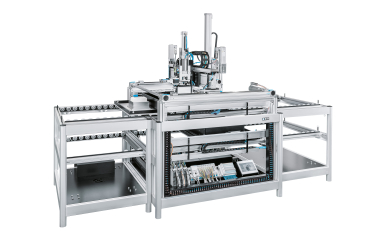
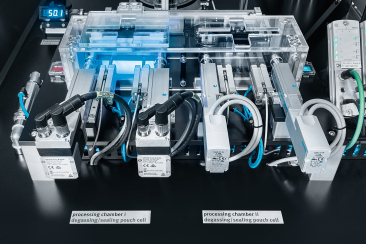
The copper-, zinc- and nickel-free automation products are components of Festo's handling solutions. They are therefore predestined for use in degassing and sealing. These core processes in battery cell production directly follow the initial contacting of the battery cells with electrical voltage. The battery cells are pierced with lances and the forming gas produced during contacting is extracted. Pneumatic and electric actuators from Festo ensure the handling and piercing of the battery cells.
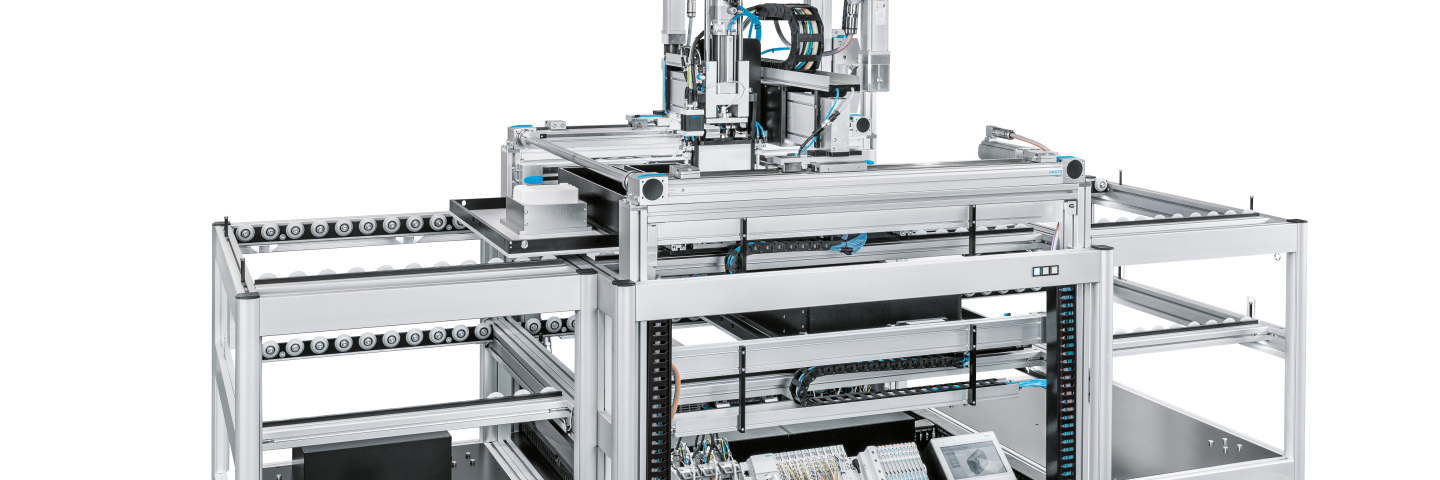
High speeds, high throughput, reliability and repeat accuracy - these are the features that Festo handling solutions offer in these processes. For example, cantilever handling based on Festo's ELGT spindle axes ensures dynamic and safe loading and unloading of the process chambers. The compact and cost-effective ELGT spindle axes from Festo with integrated double guide can be ideally combined into 2D and 3D cantilever systems.
Right up to the electric drive train
The efficient production of electric drivetrain components is a decisive factor in the economic success of electromobility. Alongside the electric motor, the battery pack forms the centrepiece. In battery module and pack assembly, the factors of variable production volumes and component geometries as well as occupational safety and continuous monitoring play a key role in minimising risk. The key to increased efficiency is the use of suitable cross-technology handling solutions. In combination with a standardisation strategy that pays off at an early stage of the project, economies of scale can be achieved from batch size 2. Reproducible and transferable process parameters optimise commissioning. The reduced variance in components guarantees the efficient supply of spare parts and simultaneously reduces downtimes that could be caused by critical, process-relevant components.
The drive technology and sensors from Festo ensure the desired high degree of automation of the individual process steps. Handling solutions with a mix of electrics and pneumatics combine the advantages of both technologies and enable the robust, safe and precise gripping and transporting of battery cells. In a battery module handling system, the DSBC pneumatic cylinder with integrated SDAT position transmitter, FENG position measuring system and DACS safety brake in combination with the ELCC electric cantilever axis and an EMMT servomotor offers a range of positive features: In addition to the inline process control, it is the early error detection and traceability, the optimal coordination of motor and axis to the specified process as well as the low energy requirement.
Integrated safety concept
Appropriate automation technology contributes significantly to functional safety and higher system availability during battery module assembly: Pneumatic swivelling drives actively lock the cells. The sensors can be easily parameterised and set via an IO-Link interface. Parallel to the movement, an optical sensor system detects the mechanical alignment of the cell. Its polarity is measured electrically. If the voltage is incorrect, the cell is ejected. The cells tested in this way are inserted into the module housing in the appropriate orientation.
All safety-relevant function groups and components are designed redundantly. Intelligent components are used to generate, record and process data for transparent production concepts. Statistical process data monitoring analyses data and indicates, among other things, when the gripper needs to be replaced. Condition monitoring thus avoids downtimes and optimises maintenance processes.
Decentralised intelligence including CODESYS SoftMotion
A decentralised control concept with stand-alone solutions makes sense for the highest possible plant and machine availability (OEE). This results in independent stations instead of sequentially hard-chained line concepts. This is where the CPX-E-CEC control and automation system with motion control (CODESYS V3 ) opens up new possibilities: It relieves the main control system. This frees up resources that can be used for data analysis, for example. This architecture networks production for complete data acquisition and component traceability. A digital twin forms the basis for simulation purposes.
Automation and training from a single source
The production of batteries and electric vehicles requires trained employees worldwide. Festo Didactic offers industry-specific learning concepts to quickly train and familiarise the large number of employees who often do not have the right training or expertise: From access to the Festo LX learning platform for self-study to learning factories for "hands-on" training with knowledge transfer to the shop floor.
Festo is a global player and an independent family-owned company with headquarters in Esslingen am Neckar, Germany. Festo has set standards in industrial automation technology and technical education ever since its establishment, thereby making a contribution to sustainable development of the environment, the economy and society. The company supplies pneumatic and electrical automation technology to 300,000 customers of factory and process automation in over 35 industries. Digitalization, AI and the LifeTech sector with medical technology and laboratory automation are becoming increasingly important. The products and services are available in 176 countries. With about 20,600 employees in over 250 branch offices in around 60 countries worldwide, Festo achieved a turnover of around €3.33 billion in 2025. More than 8% of this turnover is invested in research and development. In this learning company, 1.5 % of turnover is invested in basic and further training. Festo Didactic SE is a leading provider of technical education and training and offers its customers worldwide comprehensive digital and physical learning solutions in the industrial environment.